
May 2025 Newsletter

Resources in MA Regardless of Immigration Status Spotlight on Temporary Protected StatusHow to Talk About Immigration StatusHow Care Teams Can Support Immigrant Families

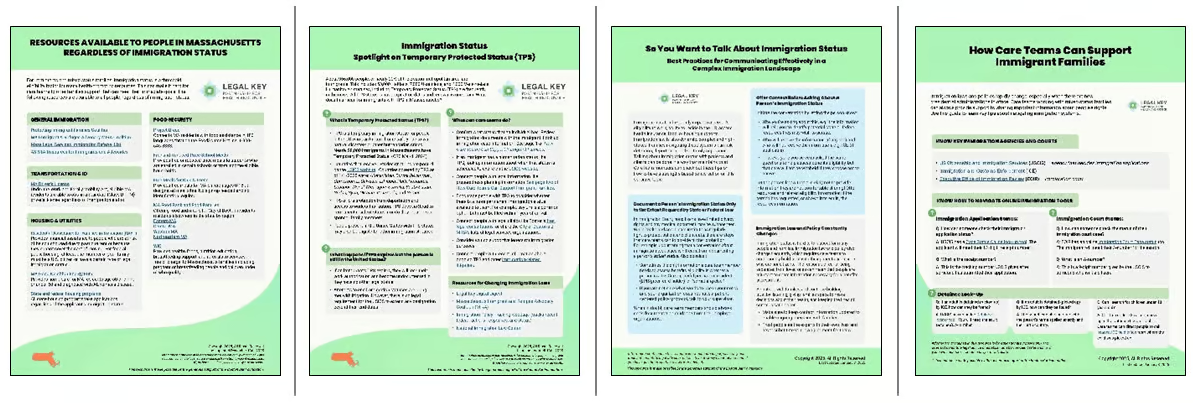
Legal Key recently published four guides on some of the changing laws that impact immigrants. With generous funding from the Boston Bar Foundation, we have been able to translate these guides into Portuguese, Haitian Creole, and Spanish.

We focused these resources on common practical questions that we field frequently, such as how to find out if someone has an immigration hearing, how to start a conversation about immigration status, and what documents every immigrant should have in order.


Law & Policy Consultant, Sarah Yan, and Law & Policy Director, Jeannine Casselman, presented at Community Health Institute sponsored by the Mass League of Community Health Centers. After the session, they met up with our Advisory Board Vice Chair, Dr. Cheryl Clark.
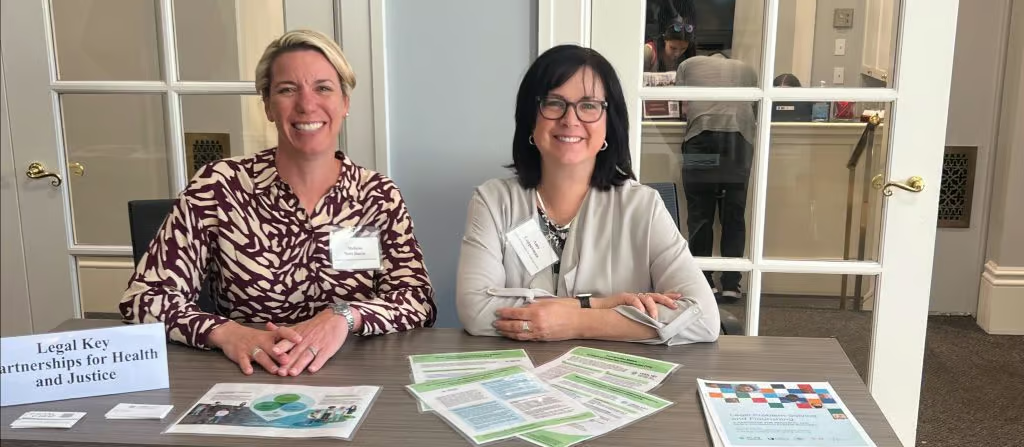
Legal Key’s Advisory Board Chair, Melissa Nott Davis, and Executive Director, Amy Copperman, attended the Boston Bar Association’s Charitable Board Service Recruitment Fair on May 14.
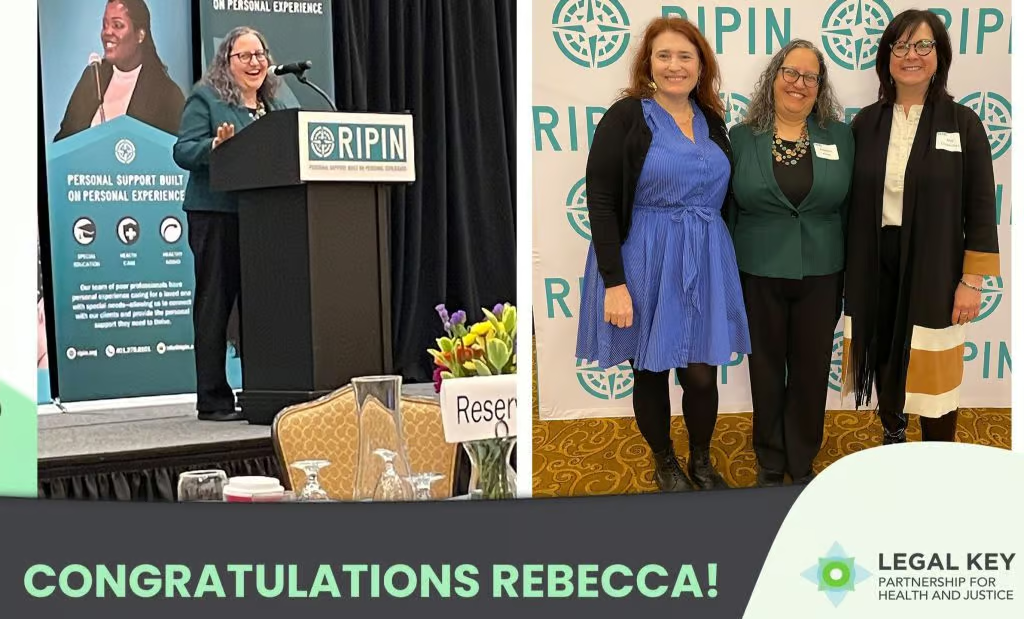
We are so proud of our Law & Policy Consultant, Rebecca Kislak, who was honored with a 2025 Partnership Award at the RIPIN Annual Breakfast on May 22.


Massachusetts
Eviction sealing has come to Massachusetts! Check out our Digital Digest to learn more about which evictions are eligible to be sealed, opening new pathways to housing. Helpful information for tenants is also available at www.SealMyEviction.Org.

Rhode Island
The Rhode Island Department of Health has created a searchable public database that allows anyone to access contact Subject to approval by the Food and Nutrition Service, SUN Bucks, formerly known as Summer EBT, will be issued June 9th to eligible RI families. This is a one-time payment of $120 per eligible child. Students who receive SNAP, RI Works, Medicaid or who live in a household with a child receiving these benefits will have their SUN Buck dispersed automatically to their existing EBT card. For other families, applications are available.

Federal
The administration has enacted changes targeting immigrants in the US, including revoking Temporary Protected Status for Venezuela and Haiti, ordering the registration of certain noncitizens in the US, and indefinitely suspending American-sponsored humanitarian parole programs. Click here for more updates on Immigration-related topics.


May 23, 2025

We are so pleased to spread the word about several new Legal Key resources that are available to the public on our Unlocking Access® Hub. Thanks to support from the Boston Bar Foundation, we have developed and translated several guides related to immigration law. These guides, all available in English, Spanish, Haitian Creole, and Portuguese, are:

It should come as little surprise that since January, Legal Key has seen a spike in questions from care team partners related to immigration law and how immigration status impacts access to services. Some consults have focused on informational questions, such as understanding a person’s immigration status or clarifying eligibility rules for benefits. But increasingly, care teams are seeking answers for alarming and unsafe situations: how to help a parent plan for their child’s care in case the parent is deported or how to deliver health care to someone who does not come to an appointment out of fear.

Legal Key has been working to support our partners with training, materials, and consults that explain shifts in immigration law and highlight any steps they can take in response. Part of Legal Key’s role is to communicate clearly what is an actual change in the law, what is still just a proposed change, and what pronouncements are wishful thinking on the part of the federal administration.

We encourage you to download and share these guides widely with anyone who might benefit. An additional guide, Obtaining Passports for Children Under 16, will soon be available. And be sure to visit and bookmark our open-access Digital Digest, which is updated regularly to reflect changes to state and federal law and policy across a number of legal domains.

The power balance is so great, and the stakes are so high — family, safety, health and security are at risk for tens of thousands of US residents. And there has never been a more important time for people to have knowledge about legal rights and systems to make informed decisions.


Legal Key was thrilled to attend the Together for Hope 2025 conference in Worcester earlier this month hosted by the Grayken Center for Addiction at Boston Medical Center. Our poster, How to Utilize Legal Problem Solving to Support Patients with Substance Use Disorder, was very well received. There was so much great information to take in, and the speakers and performers were an inspiration.

We look forward to incorporating what we learned into our work supporting partners who serve patients with substance use disorder.


Bridging Divides logo

Legal Key’s April Unlocking Access® training for partners was titled First 100 Days. We presented on some of the changes in federal law and policy in recent months, and how those changes are impacting health and safety. Our Law & Policy Consultant, Rebecca Kislak, wrote our latest blog post as a companion to the training, where she highlights how to navigate these rapid changes.


Legal Key, along with our partner The Children’s Trust and the team at Tufts Interdisciplinary Evaluation Research (TIER), is participating in the Root Cause Coalition’s Voices of Health Equity speaker series on May 9. Our session, Expanding Family Supports with Legal Problem-Solving: How a Home Visiting Program and a Medical Legal Partnership Created a Unique Service Delivery Modelwill cover recent findings about how Legal Key’s work impacts care teams and those they serve. It will be hosted online from 12-1p, and there is still time to register to attend!


In Case You Missed It! Check out our 2024 Year In Review for a roundup of last year’s work. Each member of the Legal Key team contributed so much to our success, and we carry that sense of gratitude and purpose with us into 2025.


Massachusetts
Accessory Dwelling Units (ADUs) (also known as in-law apartments) are now easier to build, by right. This new provision in state law will let property owners zoned for single family homes build a second unit up to 900 square feet either attached or free-standing. This change will open up pathways for new, affordable housing.

Rhode Island
The Rhode Island Department of Health has created a searchable public database that allows anyone to access contact information for landlords and property managers, as well as basic information about each rental property, such as certificates of deleading.

April 29, 2025

As a team, we at Legal Key have been reflecting on the uncertainty of the last few months. How can we best support our partners in the face of so much unpredictability? How are our care teams faring? How are their patients and clients?

Legal Key Law & Policy Consultants have received many questions since January relating to changes in immigration laws. The stress that care partners and the people they support is intense and real. Our first three Unlocking Access® trainings (our monthly training series for partners) in 2025 focused solely on immigration.

Then in late April we conducted a training, First 100 Days, covering topics beyond immigration that the federal administration has proposed to change in their first 100 days. By our count, as of April 25 the President has signed 139 executive orders, 37 memoranda, and 39 proclamations. These various documents target basic needs such as access to housing, education, Social Security, health care, and more.

While it is easy to get overwhelmed by the sheer volume of these pronouncements, it is important to remember that proposed changes to federal law or funding do not always mean the changes will go into effect. Some changes, such as those impacting federal funding, agencies, or staffing, have begun to be implemented. But some have not, because they have been paused by our courts or require Congress to act. And the federal government cannot generally change state or local laws.

And yes, in many cases, we have more questions than answers. We still don’t know what is happening with things such as student loans, or subsidized housing, or access to Social Security.

Above all, it is important to remember that across the country, and certainly in Massachusetts and Rhode Island, court cases are challenging many of the proposed changes to federal law, policy, and  funding. Courts are making decisions daily, and many of them have blocked administration proposals. In fact, both before and after our April training session, new presidential and court actions meant information changed two times that day — even Legal Key has a hard time keeping up sometimes!

The common themes that emerged from our First 100 Days training were that the legal landscape continues to be very uncertain, and the pace of change is happening so quickly that it is hard to keep up. But Legal Key is committed to help our partners and collaborators stay informed in real time about updates to the law and to equip them with accurate and actionable information. And in that way, we will navigate these difficult times together. 


Our 2024 Year In Review is hot off the virtual presses! 2024 was a big year for us–we developed our strategic plan, got ready for our name change, completed 1,010 legal consults, delivered 41 trainings to more than 1,000 attendees, and so much more. Our Executive Director Amy Copperman penned a blog, and you can read and download the full report here.

Legal Key is thrilled to receive support from the Boston Bar Foundation to fund the creation and translation of key immigration know-your-rights guides. Two of the guides are already posted on our website in English: How Care Teams Can Support Immigrant Families and So You Want To Talk About Immigration Status. Keep an eye out for the completed set of translated guides on our website.

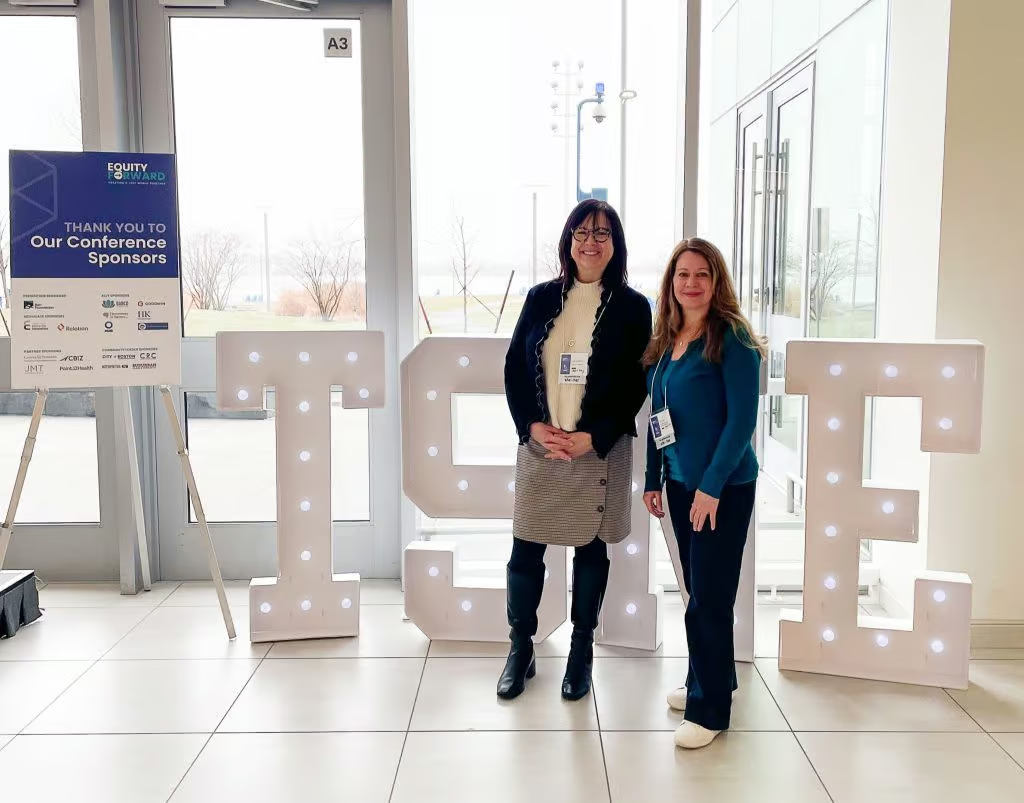
Legal Key Admin & Finance Manager Meg Baker and Executive Director Amy Copperman traveled to UMass Boston in late March to attend Equity Forward conference. Our fiscal sponsor Third Sector New England, Inc. (TSNE) hosted a bold and informative conference with a day of programming focused on building an equitable world across all parts of the nonprofit sector. Bonus—we got to meet many of our TSNE Fiscal Sponsorship team in person for the first time!

Legal Key is a proud participant of the Rhode Island Life Index, a project that surveys residents on key topics like education, job opportunities, and food access, to guide community health initiatives statewide.

If you are 18+, live in RI, read English or Spanish, and have a working email, you can complete the surveys. There are 3-4 short surveys per year, and you can earn $5-$10 gift cards per survey (up to $25 annually). Find out more below!

It’s been just over a month since we transitioned to Legal Key Partnership for Health and Justice, or Legal Key for short. We have been overwhelmed with the positive response from our partners and stakeholders. Check out our blog post on how we got here, and be sure you follow us at our new profile page on LinkedIn!


Legal Key is pleased to share our 2024 Year in Review. Take a peek inside to see what we accomplished in the past year. It turns out we did a lot!

A few highlights: we completed 1,010 legal consults and delivered 41 trainings to more than 1,000 individuals. One of our biggest milestones in 2024 was completing a comprehensive strategic planning process. I am especially appreciative to everyone who engaged in this process, including each staff member, our Advisory Board, and dozens of our partners and stakeholders. Our strategic plan gives us important milestones to aim for and represents a true collective vision of the direction that the organization is headed. 

As I reflect on my second year as Executive Director, I find that what I feel above all is gratitude–I am grateful to be in this role at this time with this talented and creative team. This report uplifts not just the array of activities we undertook in 2024, but how the work we do reflects our values. We believe in knowledge sharing, transparency, and action. We believe that society is better when more of us understand how to navigate the systems that are responsible for our wellbeing and safety.

We will hold onto these foundational values in 2025, as we enter some choppy waters, to embody our work towards justice and wellbeing.


Our team is thrilled to announce that our new program name is here. We are now officially Legal Key Partnership for Health and Justice. Just call us Legal Key for short! Our name, website, and emails may have changed, but in many ways Legal Key is a more perfect expression of our vision and mission.

Why did we land on the word KEY? If something is key, it is importantcritical, and vital. A key creates access, opens up something new, and illuminates a way forward. This one small word embodies all that we strive to do as an organization. 

If you want a more detailed peek into our process, check out our latest blog post. And be sure you follow us at our new profile page on LinkedIn!


2025 is going to be a lot of things, many of which are hard to predict at this moment only days after the inauguration. But here at MLPB, we know one thing for sure — we will have a big announcement to share with our community in February. Many of you know that it has been in the works for a while to change our name, and it’s finally happening! And before you ask…we still can’t tell you yet. Stay tuned to this newsletter, our website and our LinkedIn page for all of the details. 


We knew the new federal administration would focus on immigration, and they wasted no time. MLPB has already received an avalanche of requests for information and training about what to expect.

The reality is, even if we know what the administration might want to change, we won’t know the outcomes for a long time. So for now, we are making two of our most fundamental immigration resources available to the general public. See the links below for best practices for communicating effectively in a complex and dynamic immigration landscape. Feel free to share widely. 

Immigration laws and policies rapidly change, especially when there are new presidential administrations in office. Care teams working with mixed-status families can always provide support by sharing important information about people’s rights. Use this guide to learn key tips about navigating immigration systems.

Immigration status frequently impacts a person’s eligibility to work and to access health insurance, food, or housing supports. Families navigating these systems can risk detention, deportation, and/or family separation. Care team members can talk to patients and clients about immigration status, but it is important to engage in a way that builds trust. Check out these tips on how to have a strengths-based conversation on this sensitive topic.


MLPB staff and Advisory Board members gathered in December to celebrate the completion of our strategic plan and the accomplishments of the year. Our Advisory Board is a vital part of MLPB, and we appreciate being able to tap into their wisdom and energy.


Bridging Divides banner

Read our latest blog post covering why the recent decision in Garcia et al. v. Executive Office of Housing and Livable Communities is so significant for families seeking emergency shelter.


Policy Corner banner

MLPB stands in solidarity with our fiscal sponsor TSNE in their opposition to H.R. 9495, a bill that would give the U.S. Treasury unprecedented power to strip nonprofit organizations of tax-exempt status. The broad language of the bill opens the door to retribution against organizations by a sitting president; one Congressperson called it a “death penalty” for nonprofits. The work of nonprofit organizations is more critical today than ever. Read TSNE’s statement here.


Warmest Wishes banner

We at MLPB have a lot to be grateful for this year. First, we celebrate the completion of our strategic planning process, which has given us a renewed sense of focus and purpose (more on that in January!) We uplift our continuing and growing partnerships, where we work with incredible people who are dedicated to understanding how legal issues impact wellbeing. We are thankful for our fiscal sponsor TSNE, who provides us with collaborative systems support so we can focus on our mission-centered work. Our Advisory Board members support the team with their wisdom and guidance. And I personally am grateful for our staff members — Meg, Sarah, Jeff, Rebecca, Terrence, Jeannine and Stephanie — who each bring creativity, dedication, and compassion to the organization every day.

As we close out the year, we all feel deeply the uncertainty of what lies ahead. While we expect there to be many challenges to our work in 2025, I am grateful that we will face those challenges together.

In solidarity for peace and justice,

Amy

PS — We hope you will consider supporting MLPB with a donation. Thank you!

Amy Copperman, MLPB Executive Director

December 16, 2024

MLPB celebrates an important legal victory for those seeking emergency shelter in Massachusetts in a case called Garcia et al. v. Executive Office of Housing and Livable Communities (EOHLC). In the latest phase of this long-standing class action lawsuit, the court considered what documentation families in crisis need to provide to access shelter, and when they need to provide it. Even though the law allows for shelter placement pending document verification, EOHLC was in some cases denying families for failure to produce the correct papers first.

The families served by the Emergency Assistance program are never applying for shelter under the best circumstances. The highest priorities for Emergency Shelter in Massachusetts are there to support our most vulnerable residents, such as those who are fleeing domestic violence, have lost everything after a natural disaster, or have sought medical care for the effects of living in uninhabitable conditions.

MLPB, together with the Health Law Clinic at Suffolk Law School, submitted an amicus letter on behalf of the plaintiffs in Garcia, highlighting the connections between homelessness and health. Our statement also provided some concrete stories drawn from MLPB’s legal consults. For example, MLPB supported a care team working with a mother and child who had only a few minutes to make the decision to flee a violent situation without tipping off her abuser. They left the home with just the clothes on their backs, and most importantly, they deliberately left behind their identity documents in an attempt to get to safety before the abusive family member realized they were gone. The rules in place to get families into shelter pending verification are there precisely to help this family and others in their situation overcome their crisis.

Arguments were heard in September, and in November, the Massachusetts Supreme Judicial Court issued a ruling that held that the state could not deny families seeking emergency shelter placement for failure to provide verification of eligibility at the time of initial application. MLPB applauds the decision. It is not only the most correct reading of existing law, but also confirmation that our laws are best when they incorporate a compassionate and person-centered approach. 


Like many other justice-seeking organizations, we at MLPB have been reflecting and processing the results of the recent election. While so much is still uncertain, a few thoughts are becoming clear.

MLPB’s mission is to create access to legal knowledge for health and social service sectors and empower those communities to use legal problem-solving to improve wellbeing. And at the core of our mission is the idea that knowledge is power.

The law is not just sitting in dusty old books. It is a living, breathing body of work that impacts our daily lives in profound ways. The law influences where we live and work, who we love, whether we are safe, and what supports we need to live a healthy life. In an ideal world, our laws provide the aspirational road map that centers dignity and respect, that holds corporations and government bodies accountable, that provides support for the communities who need help most, and that protects us all from greed, discrimination, violence, and other human-created harms.

If there is one thing that is constant about our legal systems, however, it is that change is always underfoot. And navigating through change is MLPB’s specialty. Even without knowing precisely what is ahead, MLPB is ready to cut through the noise of confusion to ensure that everyone can access the knowledge and resources they need to assert their rights.

In the coming weeks, MLPB will be supporting our partner communities by identifying problem-solving strategies that, despite uncertainty, can be implemented today. And we will be forging alliances in order to advocate for our ideals and to keep striving for health and legal solutions far into the future.


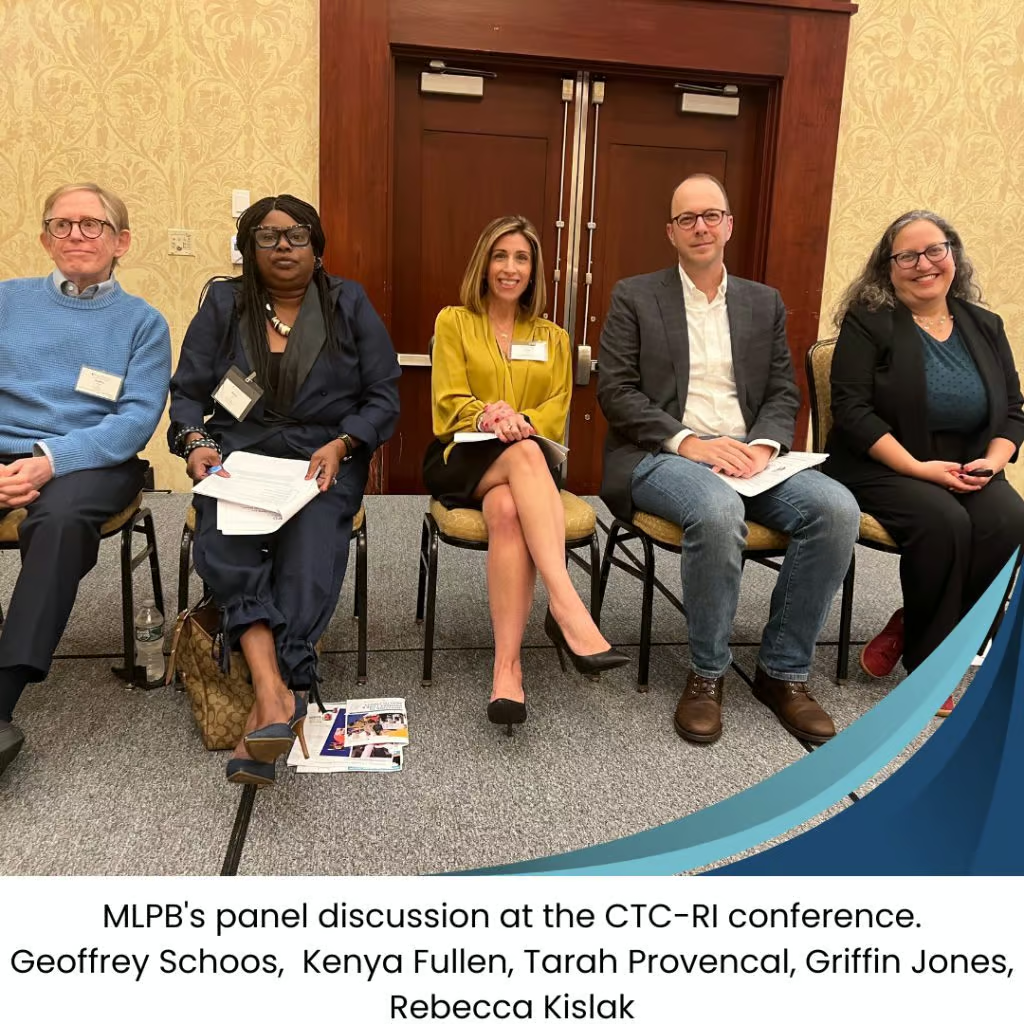
MLPB staff have been out and about in the last few weeks! MLPB’s Executive Director Amy Copperman, Law & Policy Director Jeannine Casselman, and LPC Rebecca Kislak were all in attendance at CTC-RI’s Annual Conference on Halloween. There, Rebecca moderated a panel discussing the findings of MLPB’s Learning-and-Action Lab.

Our Partnership & Project Manager Jeff Gilbert and LPC Sarah Yan attended a kick off meeting at Metro Housing | Boston.

Law & Policy Consultants (LPCs) Stephanie Duggan-Lykes and Sarah Yan presented a training on the rights of immigrant newcomers at the Children’s Trust’s A View From All Sides.


Deferred Action for Childhood Arrivals (DACA) is a federal program that permits certain undocumented children to work and protects them from deportation. Due to ongoing litigation, DACA is closed to new applications. DACA recipients with work permits that expire in the next six months are strongly encouraged to renew early. DACA recipients with work permits that expire in 6 months to a year may also be eligible to renew. Note that immigration rules can change quickly.

Current DACA recipients are also eligible to purchase health insurance through the ACA marketplaces such as the MassHealth Connector or HealthSourceRI. Visit MLPB’s Immigration Digital Digest for more information.


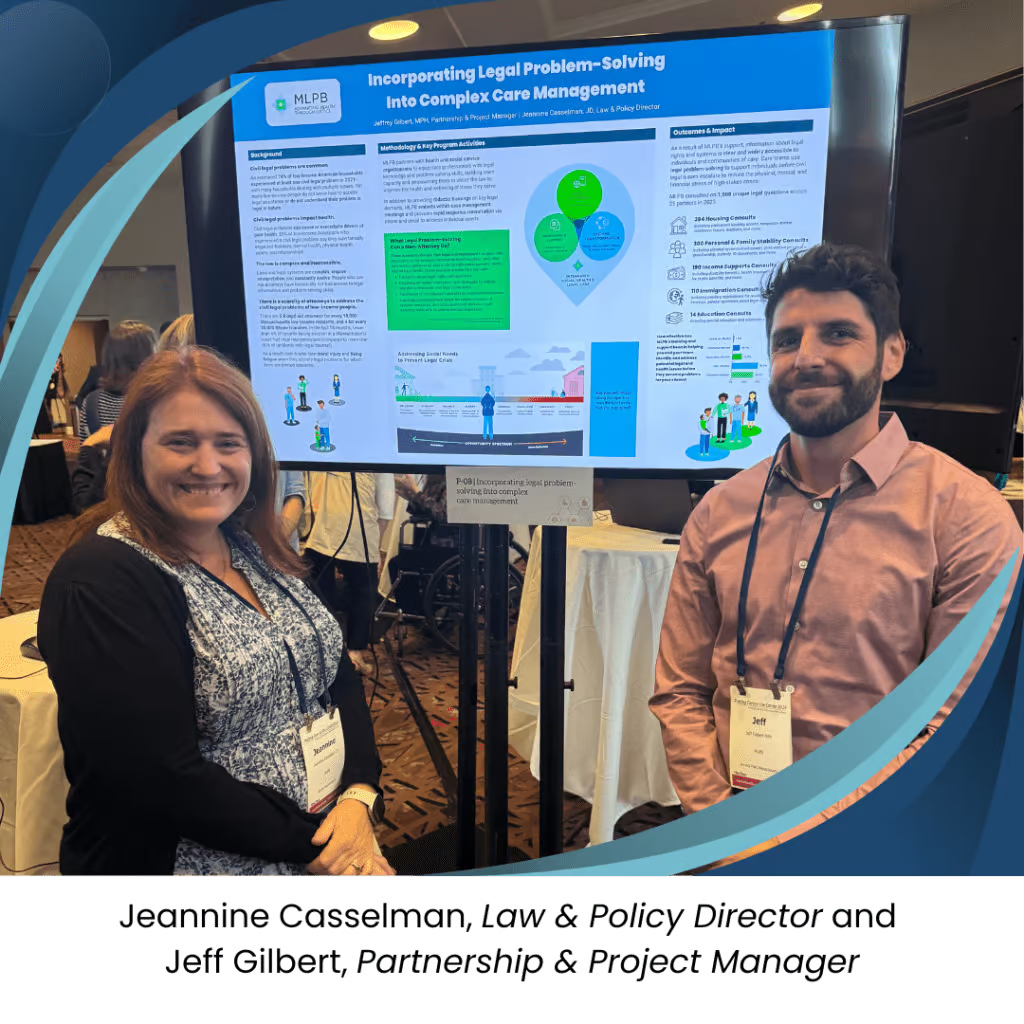
Earlier this month, MLPB’s Law & Policy Director and Partnership & Project Manager traveled to Pittsburgh to attend the Camden Coalition’s Annual Conference Putting Care at the Center and present at a poster session.

Jeannine Casselman and Jeff Gilbert highlighted some of MLPB’s work on a poster titled Incorporating Legal Problem-Solving Into Complex Care Management.

It was great to connect with folks interested in social and legal care from around the country.


Metro Housing|Boston (MHB) mobilizes wide-ranging resources to provide innovative and personalized services that lead families and individuals to housing stability, economic security, and an improved quality of life.

HomeBASE is a program of the MA Executive Office of Housing and Livable Communities (EOHLC) designed to reduce the need for shelters and motels. The goal is to assist families who are facing homelessness to find alternative solutions to entering shelter and/or motels. Program services include assessment, housing search, placement, and case management for families.


In her own words, here are Liliana’s goals for her time with MLPB:

I am currently a senior at Boston University majoring in health science on the pre-law track. I am very excited to intern with MLPB this fall semester and improve my skills in legal research and client advocacy, as well as learn how collaborative problem-solving may lead to more equitable solutions for communities.


In Massachusetts, the winter moratorium for people who have filed financial hardship forms with their utility company begins on November 15. Households with members enrolled in MassHealth or SNAP will be automatically enrolled in gas and electric bill discounts.

In Rhode Island, the winter moratorium begins on November 1 and covers protected status customers. Learn more about eligibility, the application process, and other resources.

During the winter, some states have moratoriums on utility terminations for certain customers — start dates and eligibility criteria vary from state to state.

Check with the LIHEAP Clearinghouse to see if your state has a winter moratorium.